Today I’m delighted to introduce you to the third guest in our self-publishing mini-series, Patrick Milne.

PM: We didn’t really even think of the traditional publishing route initially. We just tried to get the story together as much as possible in a 32-page structure, which was difficult because it was the first time we’d done anything so short. It was definitely an exercise in brevity! During the process, it seemed any time we brought up the idea of a publisher and looked around at their respective websites, or researched agents, either they weren’t accepting manuscripts or you had to jump through hoops to get it to them. We continued working away until the story took shape and by then, we both really loved it and couldn’t have fathomed changing anything about it.
PM: Once we got our hard copy proof copy back from the printer, Stephanie, the book’s artist, took it to a small publisher’s fair in Vancouver. She got interest from several companies but each had their own list of changes they wanted to make. By that point, we’d been working on the book for so long, Stephanie especially with all of the art and coloring, that thinking about incorporating their changes was just too overwhelming. At that point, we officially decided to move ahead on our own.
PM: We found a small printing company in Winnipeg, Manitoba called Art Book Bindery that had a great reputation. We knew we wanted to do at least a small run of print copies so we worked with them. The electronic version was formatted and uploaded to Amazon several months later.
PM: No, I’ve had several jobs as a copy editor in the past so I was very confident in my own abilities. We also passed it around to some family and friends to make sure everything was coherent and had a nice flow and rhythm to it, but the words, sentences, and grammar I was very possessive about. Outside opinions were really key for us because when you work on the same story and the same sentences, you can miss little things
PM: My illustrator was my sister, Stephanie Faye, who is a graduate of Capilano University in British Columbia and had been working in children’s television and animation for several years previous. We sent the manuscript back and forth over email and had conversations over Skype about it. Once she began the illustrations, she sent her drafts to me through email and we discussed them every few days. It was a very collaborative effort for being so far apart.

PM: We currently sell the print version through our website and at various local craft sales around Christmas time and it does quite well. The ebook version, Stephanie formatted from her finished files and they were formatted in a .mobi file for the Kindle and uploaded to Amazon. We’re working on getting it into different places on the web to broaden Lucy’s availability but as of right now, those are the primary outlets.
PM: Selling the print copies at various fairs has been the most successful approach for the print version. The electronic version has been totally different. There are thousands of ways of going about marketing our book, the only problem is where to start. We currently use Twitter and Facebook and I’ve started a blog called So Much To Be Read to help build a community and get the word out on other children’s authors and illustrators just like me who are self-published. There is so much more to do and I feel like all we have to do is just start!
PM: We did a seminar with a local grade seven English class that was doing a unit on writing their own picture book and sold many of the print copies there but no e-book versions that I know of. It’s something we’d certainly like to keep doing.
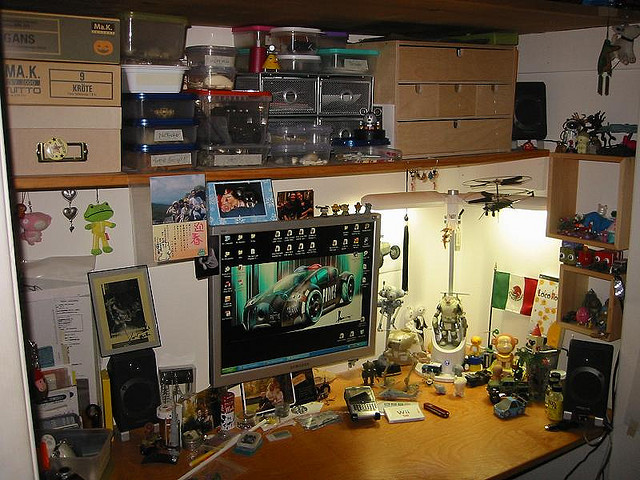 |
| Patrick’s office |
SLH: What advice would you give other authors who are thinking about self-publishing?
PM: I think the single most important thing to understand is that finishing the book is only a small part of what self-publishing is all about. Depending on your hopes for the book and what it might become, all the rest is marketing – thinking about who your audience is and where to find them and how to get the word out about your book without coming across as a desperate spammer! On the one hand, it’s a very frustrating process, but on the other, you’re only as limited as your imagination. Furthermore, there has never been a time in history when reaching people has been as simple as this. We get a lot of motivation and inspiration from keeping that in our mindset.
PM: Trust your instincts and stay true to what your book is all about and why you wanted to write it in the first place. If we had decided to incorporate the changes suggested to us by the various publishers, I don’t think I would feel quite as passionately about Lucy Snigglefritz as I do now, or as proud. If it set us back from getting a publishing contract, so be it. I don’t see any evidence these days that working with a publisher is any less challenging than the self-publishing route.
Thank you so much, Patrick! It is so interesting to hear from different authors who have chosen this route. We all have a lot to learn from you.
Folks, please feel free to visit Patrick on his Website, follow him on Twitter @fayemousbooks, or network with him on LinkedIn. Patrick has kindly offered to be available for questions, so please ask if you have any! In addition, he is giving away a free e-copy of The Adventures Of Lucy Snigglefritz – I have seen it and it’s very cute even on my black and white Kindle! – so if you’re interested in qualifying, please leave a comment saying why you’d like to have the book!
Thank you all for joining us! Have a great weekend!
 Susanna Leonard Hill