Welcome to this Thursday Edition of Tuesday Debut, Everyone!
We’re having such a busy week!
And learning so much from so many authors!
We’re going to just jump right in today because we’ve had a lot of posts this week and there’s still Perfect Picture Book Friday tomorrow!
Today’s debut is an Early Reader – also known as a Beginning Reader or a Leveled Reader – and our author has a ton of very helpful information to share for those of you who might be interested in trying your hand at this little step up from picture books.
He is offering an amazing giveaway, too! A 30 minute AMA zoom call that can include industry talk, pitches, or manuscript advice. He is happy to talk with an individual or a group if the winner wants to include others. To get yourself in the running to be the randomly selected winner of this fabulous opportunity, please leave a comment on today’s post by Monday October 5th at 3 PM Eastern.
And now, without further ado, it is my pleasure to introduce you to (well, technically re-introduce you to, because he has been here before for a picture book debut FREE TO BE FABULOUS, and a board book on Perfect Picture Book Friday ROCK ‘N’ ROLL BABY !) the one and only David McMullin!
Title: The Nose (book 1 in the Percy & Speck early reader series)
Author: David McMullin
Illustrator: Lauren Stohler
Publishing House: Simon Spotlight
Date of Publication: September 15, 2026
Fiction or Nonfiction: fiction
ISBN: 9798347106356
age range of your book: 3-5
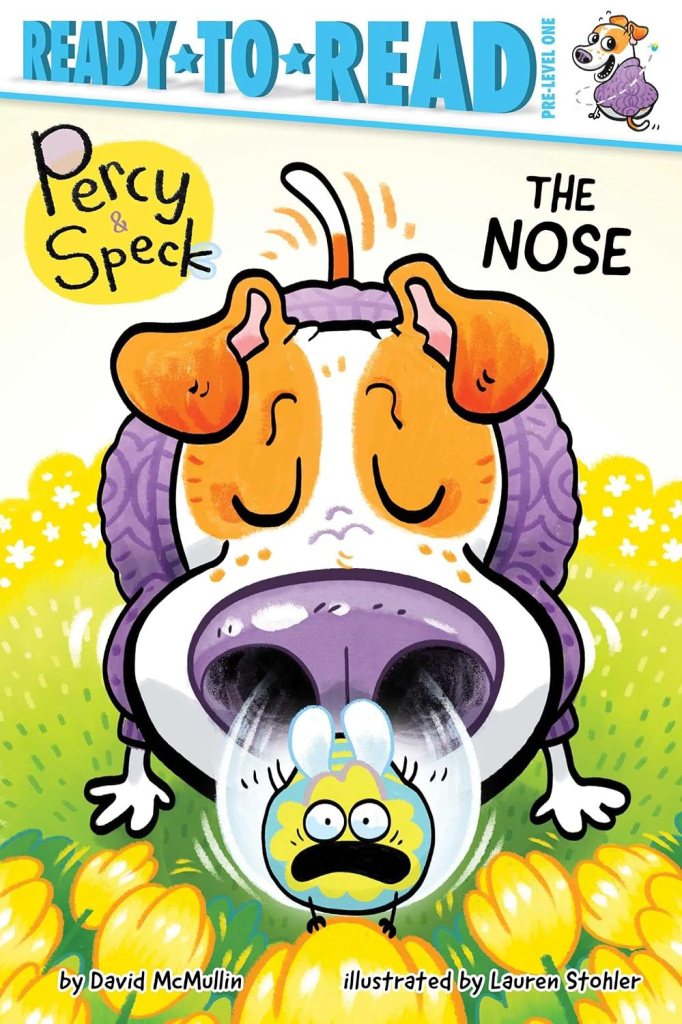
Percy is a dog. Speck is a bug. When Speck gets stuck in Percy’s nose, they are in for one silly adventure!
SUSANNA: Welcome back, David! We are thrilled to have you here again. You are so versatile – first a picture book, then a board book, now and early reader! Where did the idea for this book come from?
DAVID: This one is two ideas smashed together. While reading the expansive Game Of Thrones series, I enjoyed that each chapter furthered the plot through a different character’s point of view. I wondered if I could do something similar with a picture book. I decided to narrow the scope down to two characters experiencing one event in very different ways.
… So I had a concept, now I needed a story. That came when out for a walk one day. I got several bugs in my mouth and eyes, and realized that for as unpleasant as it was for me, it was much worse for the bugs.
I mashed the ideas together thinking … what if the book could be read in three different ways? If the reader reads only the left side of each spread they see Percy’s version of the story. It they read the right side they discover Speck’s perspective. Finally the reader can read both together and see how the character’s actions affect each other.
I knew this was unconventional, but I write everything that pops into my head. It doesn’t always pay off, but sometimes, like in this case, I end up with something I absolutely love.
(SUSANNA: I usually put illustration samples in the illustration discussion further down, but because of David’s unique vision, I’m putting them here so you can see how his vision came to life!)
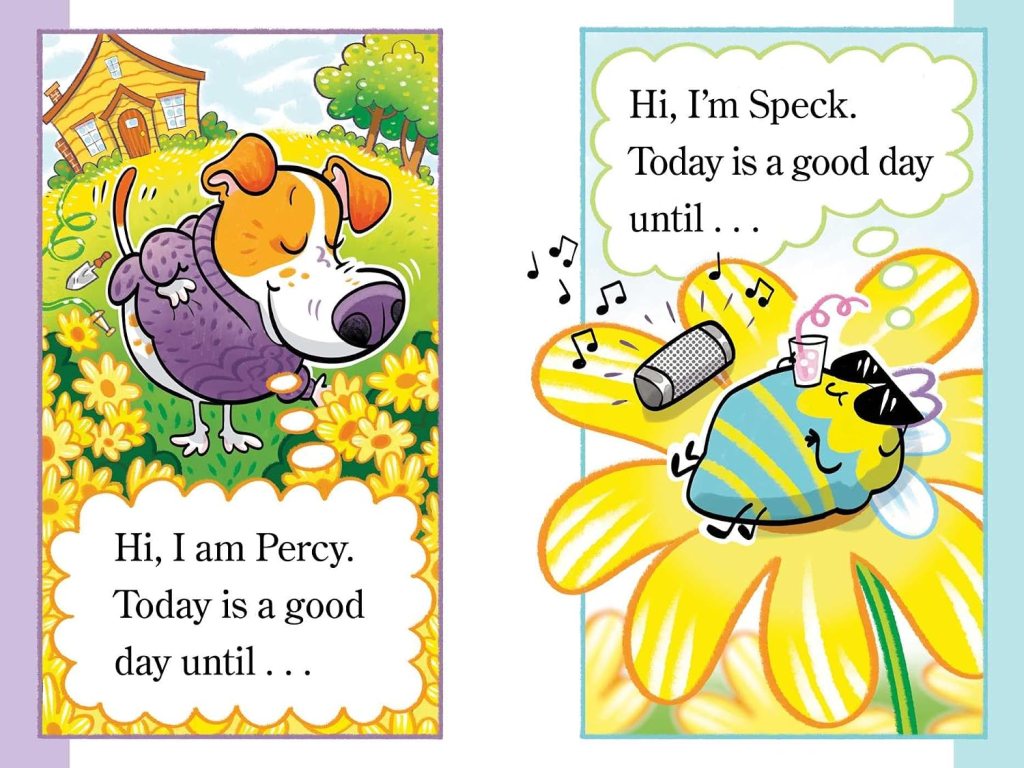
text copyright David McMullin 2026, illustration copyright Lauren Stohler 2026, Simon Spotlight
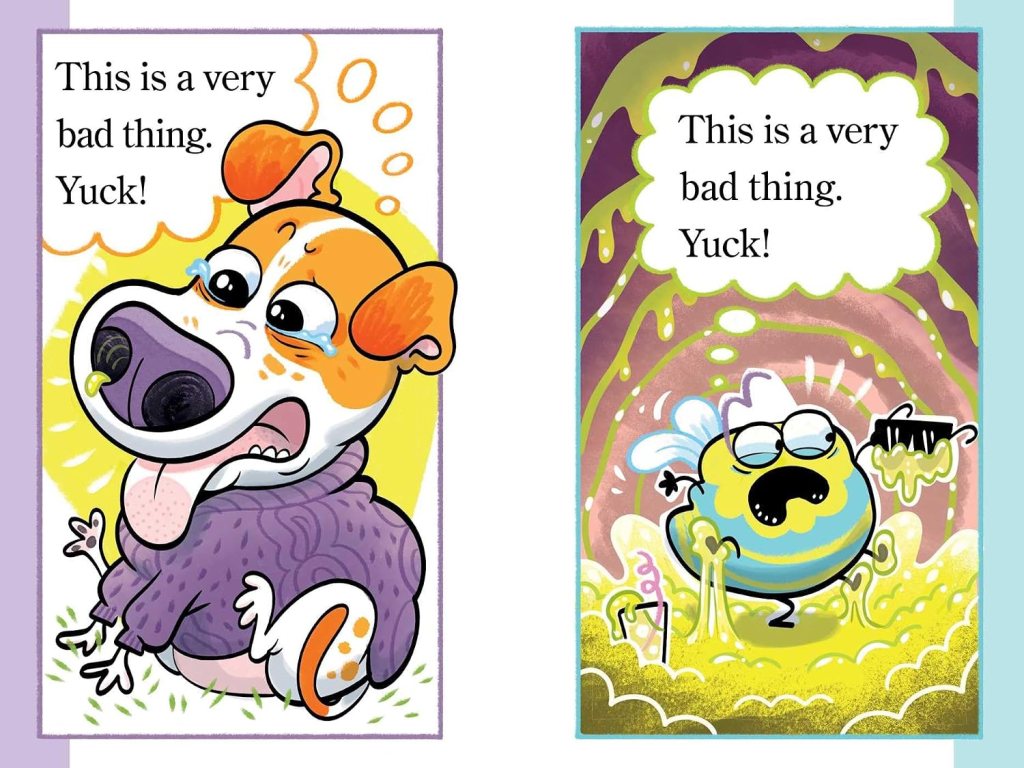
text copyright David McMullin 2026, illustration copyright Lauren Stohler 2026, Simon Spotlight
SUSANNA: Did you intend for it to be an Early Reader right from the beginning?
DAVID: No. I originally wrote it as a picture book back in 2018, but I wasn’t getting it to work. Six years later I dug it up to see if I could breathe some life into it. While working, I noticed that my sentences were becoming simpler and the relationship between the characters was becoming central. It reminded me of early readers I had read. That’s when I made the switch.
SUSANNA: How do you go about writing an Early Reader as opposed to a picture book?
DAVID: In both forms, the words and pictures carry equal importance, they are both 32 pages, and they both introduce basic plots and character arcs to kids. What makes them different is that while picture books are meant to be a shared experience between a child and an adult, an early reader’s goal is to foster independent reading.
Now, I will explain some of the challenges of writing and selling an early reader and what I did to get around those problems:
1. Many publishers use in house writers. There was nothing I could do about this.
2. ERs are often created by a single author/illustrator. Also, nothing I could do.
3. Many ERs use characters from existing popular franchises. And yet again, nothing I could do. My concept was original.
4. ERs are usually sold as a series. Finally, something I could address. I brainstormed dozens of ideas that matched my theme of perspectives. I picked my two favorites, and wrote them out as full polished manuscripts.
5. Many publishers require specific word lists. I was planning to submit widely, so I couldn’t use a specific publisher’s word list. What I did was model my words and sentences on existing early readers. I used mostly one syllable words – never longer than two. I kept sentences short – three to six words. I used simple sight words, simple syntax, and repeated phrases.
SUSANNA: How long did it take you to write this book?
DAVID: Not very long. The first draft took a couple of days to write. The revision process was quick, also. I had a clear vision of what I wanted so it only took me a couple weeks of rewriting and refining.
SUSANNA: That’s amazing! Were there any mentor texts that helped you zero in on the direction you wanted to take your book?
DAVID: No specific books, but the moment I decided to try writing this as an early reader, I went to the library and read every early reader I could get a hold of. It helped me get a feel for the language, the format, and the overall vibe.
SUSANNA: Did you go through many revisions?
DAVID: This one stayed surprisingly similar from first draft to printed book. My story, characters and concept were solid. I mostly had to adjust the language. I wanted simple words, short sentences, and repeated phrases.
SUSANNA: When did you know your manuscript was ready for submission?
DAVID: I knew it was ready when every word was exactly where I wanted it. Thankfully my agent agreed. BUT because early readers almost always come in a series, didn’t move forward until I had three books that were in tip-top shape—that is when we submitted.
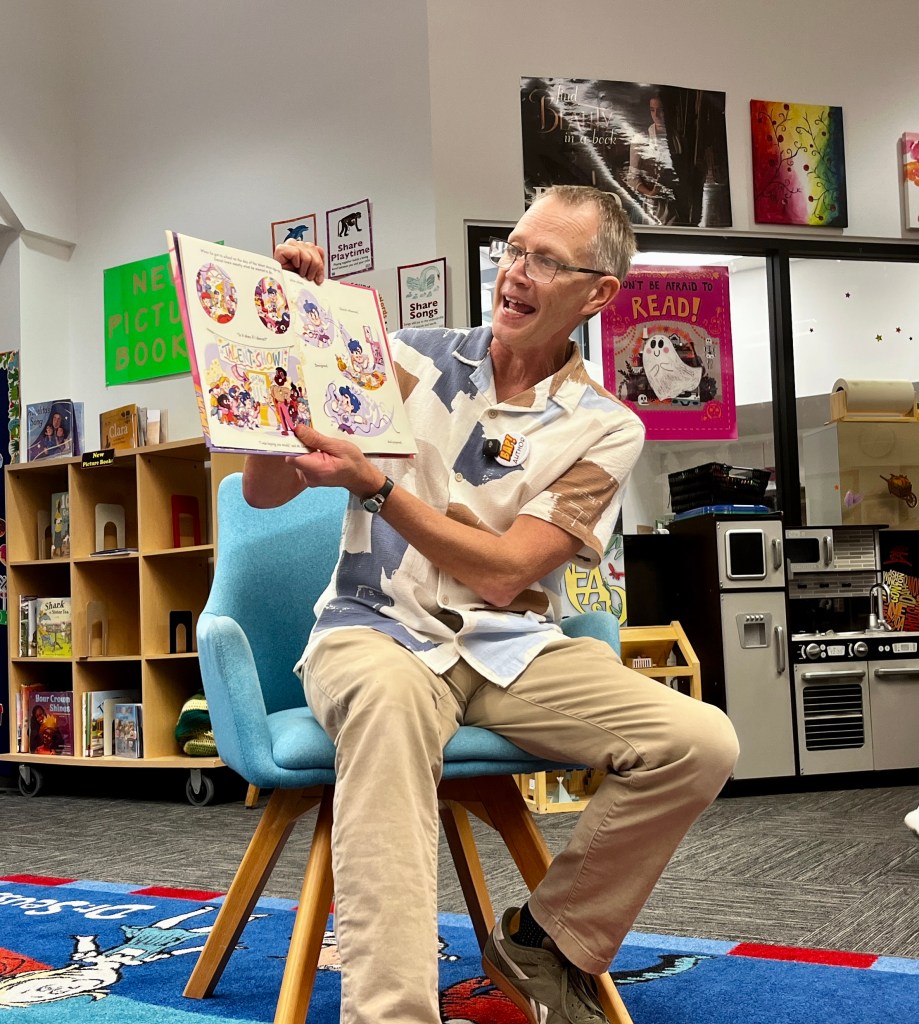
I’m not sure if this is supposed to be David’s work space or his happy space but it’s a great photo! 😊
SUSANNA: When and how did you submit?
DAVID: I submitted through my agent. She had not sold an early reader series before, so it was a learning curve for both of us.
Because of the unusual format, we worked together to create a query that not only pitched the story, but also explained the three-books-in-one concept and the series concept as a whole. I also wanted it noted that I was willing to adjust the text based on approved vocabulary lists. This made for a longer query letter, but I felt it all needed to be explained. We sent all three manuscripts as a package.
SUSANNA: How long after you found out about your book going to acquisitions (if you did) or after you submitted were you told it was a “yes”? What was that moment like? How did you celebrate?
DAVID: This manuscript was sent to twenty-one editors. One editor made an offer. It took one month between the submission and her offer. The most exciting part was hearing that she wanted all three books! I don’t remember the celebration, I’m pretty sure some sort of decadent dessert was involved.
SUSANNA: Ah! A writer after my own heart! Did you know my middle name was Decadent Dessert? 😊 How long was it between getting your offer and getting your contract to sign?
DAVID: This was very quick. I signed in just two months.
SUSANNA: Was the contract what you expected in terms of advance, royalty percentage, publication timeline, author copies etc.?
DAVID: I didn’t know what to expect, but because publishers want parents to buy full series, a majority of early readers are sold in the less expensive paperback form. Because of this, advances can be lower than picture books. My advance for the three books together was between 5K and 10K. Percentages were standard, and I got 25 author copies.
SUSANNA: Can you tell us a little about the editorial process?
DAVID: It was a dream come true. I had such a strong vision for these books, and my editor completely saw my vision. I knew it was in great hands from the beginning. Edits were very small. Most of my words were kept. We did have to add a few pages to match the already existing Ready-To-Read page count format. I also chose to adjust some text after seeing the art.
SUSANNA: What was your experience of the illustration process like?
DAVID: The process was exactly the same as my experiences with my picture book and my board book. My editor shared sketches throughout the process and always asked for my input. I loved Lauren’s art and interpretation of the character from the beginning. Her art is funny and full of action. Keeping Lauren’s dynamic characters in my mind helps me as I edit the next two books.
As far as art notes go, I did use one. On the last page I simply had the word “splat” with no other indication of what I had in mind. I added – [Speck flies into Percy’s eye]. I prefer to call art notes “clarity notes.” My intention for them is to give the editor a smoother, more accurate reading experience—I don’t write them for the artist.
SUSANNA: That is a very nice distinction, David. I like that. Did you get to see advance reviews from Kirkus, SLJ, etc? What was that like?
DAVID: I did get to see an advance review form Kirkus and it is amazing!
SUSANNA: That’s wonderful! What kind of marketing and promotion has your publisher done for this book?
DAVID: I don’t know all of the details, but my publisher is active in getting the word out. Simon and Schuster asked me to fill out an extensive questionnaire about me and my book to help them know where to send my book for reviews and awards.
SUSANNA: Describe any marketing/promotion you did for this book.
DAVID: This is the first time I have not joined a marketing group with other authors. I’m now regretting that choice as I love the community it builds, but I am thankful for the extra time working alone affords me. I am on a blog tour and have been invited on several podcasts which I love doing. I’m not great with social media, but do my best to stay visible. I don’t find that promoting an ER is any different than a picture book, but as the rest of the series comes out over the months, I will continuously have a reason to reintroduce readers to the previous books.
SUSANNA: What is the most important/helpful thing you learned on your way to publication? (Or what is your most helpful piece of advice for up and coming writers?)
DAVID: Read, read, read! I know this advice is offered all the time, but I’ll say it with a slightly different focus. Don’t just read picture books. Read board books, early readers, chapter books, early graphic novels. If I was not familiar with early readers, I may not have recognized that that is what my book needed to be. Get a feel for what makes different book categories unique and special. If you are having struggles with a picture book manuscript, you may discover that your picture book will come springing to life in a different form.
SUSANNA: Anything else you’d like to share about your book’s journey from inspiration to publication?
DAVID: If you love an idea, go for it! Be it’s champion. No one else is going to do it for you. Because early readers are a difficult sell, my agent encouraged me to pursue other manuscripts (although she did love these books, too). I had such a strong vision, hope and passion for this series that I asked that we make it our priority. I could have easily put the project back into the maybe-some-other-day file. Now it’s my new pride and joy!
SUSANNA: That is really great advice! Thank you so much for taking the time to participate in this series and paying it forward to other writers, David! This was terrific! We really appreciate the opportunity to learn from your wisdom and experience. Wishing you all the best with this and future titles!
Readers, if you have questions for David, please post them in the comments below and if he has time I’m sure he’ll respond! And remember, your comment on today’s post by Monday October 5th at 3 PM Eastern puts you in the running to be the randomly selected winner of David’s amazing giveaway of a 30 minute AMA zoom call that can include industry talk, pitches, manuscript advice, and he is happy to talk with an individual or a group if the winner wants to include others. This is a great opportunity for anyone who is thinking about Early Readers and wants to learn more!

Author David McMullin
Website: https://www.davidmcmullinbooks.com/
Instagram: https://www.instagram.com/davidmcmullinpb/
You may purchase David’s book at:
(all links below are book-specific)
Indiebound/Bookshop.org
Amazon
Barnes&Noble
We can help our debut authors successfully launch their careers by:
– purchasing their books
– recommending their books to friends and family
– recommending their books to our children’s teachers and librarians
– recommending their books to our local libraries and bookstores
– suggesting them as visiting authors at our children’s schools and our local libraries
– sharing their books on social media
– reviewing their books on Goodreads, Amazon, Barnes&Noble, and other sites where people go to learn about books.
Thank you all for stopping by to read today! Have a lovely, inspiration-filled Tuesday! Maybe today is the day you’ll write your debut picture book 😊
Missed any previous Tuesday Debuts? Check them out HERE!


Thank you for having me here, Susanna!
My pleasure, David! Thank YOU for taking the time to share all your early reader knowledge! I know a lot of people will be very interested!
Great interview! Thank you so much for the glimpse into your journey. Looking forward to reading the series!
Thank you. It’s been a fun ride.
You will love it, Patricia! I have read the first one and it’s clever and fun!
This was a great interview. I am also interested in learning about writing other genres. Congratulations to you.
Thanks. The best way to learn is by doing it. Go for it!
I think it’s very good for us as writers and as readers to explore levels in addition to picture books. There are certainly times for me – so I assume for others – when a story I write doesn’t quite end up feeling like a picture book, but might well work as an early reader or a young graphic novel, or even an early chapter book. It seems like a good idea to be open to those possibilities and to know something about how they are written, too.
Wonderful interview and full of great information how to bridge into another area of children’s publishing. I know my grade one students would love this book/series!
Lisa Carmody Doiron
Thanks so much. I hope they get to see it!
I’m so glad you found it interesting and hopefully helpful! And I think your first-graders will get a kick out of Percy and Speck 🙂
Love it! Looking forward to reading this series!
Thank you!
I’ve only read this first one, Barb, but it’s so clever and fun I think you’ll like it! 🙂
What a fascinating journey! Thanks for sharing all the details, David. The spreads you shared are hysterical. A fun series for our brand new little readers!
Thanks, I hope kids enjoy it. Lauren added so much humor to the story.
Her art is a great match for your stories, David!
So glad you enjoyed hearing from David, Kim! And I agree kids are really going to love this! 🙂
I love the three-books-in-one concept, David! The repeated phrases from different perspectives add so much humor (the spreads you shared made me snort!) and will help early readers feel more confident with the repetition. Can’t wait to read these and share them with my nephews! CONGRATS!
Aren’t those spreads great, Laura? So much fun 🙂
Thank you. Figuring out how to make the repeated phrases work was a lot of fun. Like doing a puzzle.
Congratulations, David!
He does great work, doesn’t he, Lauri?! 🙂
Thanks so much, Lauri!
Loved this interview! David’s ER sounds hilarious and I appreciated all the helpful information he gave. Congratulations!
I’ve only read the first one so far, Pat, but it is hilarious 🙂 And I’m glad you found the info David shared helpful!
Thank you. I loved learning about ERs and I hope sharing what I learned can be helpful.
Congratulations, David! I loved the interview and your book series sounds hilarious and entertaining, perfect for early readers.
So glad you loved the interview, Kim! And I agree – David has written a series kids are going to love 🙂
Thank you, Kim! I hope a lot of kids get to enjoy it.
So much great advice given here- thank you! This book looks adorable and I can’t wait to read (and learn from) it.
I hope all David’s enlightening info will be helpful to you, Tara! And I think I can safely say you will love the book 🙂
Thanks, Tara! I hope you get a chance to read it.
Congratulations, David! Thank you for sharing your journey and some great advice!
I hope David’s advice will be helpful to you in your writing!
Thank you so much! It was definitely a fun and worthwhile journey.
This was such a helpful interview…I learned something new, which is always a treat. Congrats on your series, David!
Thank you, Susan. I’s glad it was helpful. I learned a lot during the process, too!
I’m so glad you enjoyed it, Susan! I think we all learned a lot!
This looks gross and absolutely a must read. Can’t wait to see what happens to both of them!
Thank you! Yes, this one has a bit of the gross factor, but the next books in the series are not (but still funny).
It’s cute and funny 🙂 I think you’ll like it!
Congratulations, David! I love this concept for ER, and how you stood by your choice and did all the research for early readers!
Thanks, Tina! I’m glad I put in the work, too. It really paid off this time.
It’s so much fun, Tina! And yes, David really went about it the right way!
Great post, and especially interesting as I attempt a tête-bêche PB and wonder about ERs. Thank you!
So glad you enjoyed it, Poupette! So full of great information!
Thank you, and good luck with your PB—I love unusual formating.
congrats David. can’t wait to read this book. my 3 year old is already into ERs!
Wow! Good for your 3 year old! I think they’ll like this one 🙂
Thank you! I hope this series is perfect for them.
Thanks so much for sharing your adventure in writing these ERs! I know they will be a “fun” read! 🙂
I’ve only read the first one, Susan, but it’s tons of fun 🙂
Thanks! They were fun to write, so I hope so.
🙂
Wow! Thanks for the information and advice. Three ways to read – and understanding ‘perspectives’ — that’s genius. Congratulations!
(To clarify the word understanding, I meant ‘teaching kids perspectives’ or ‘helping them to see different perspectives’)
I hope the info and advice will be helpful to you in your writing! David certainly had a lot of great tips to share!
Thanks so much! It was a big concept, but I think it paid off.
Congrats on all your books and the new easy reader!
David is so talented, Jen – definitely making a name for himself!
Thank you! I am enjoying the journey!
Thank you for such an in-depth interview, David and Susanna! What a great idea of using two narrators! I love it! Appreciate you sharing how you use clarity notes as well. I learned so much from you, David! Congratulations on your books!
Peace,
Sharon Chocolate Concoction Korzelius 🙂
I’m so glad you found David’s interview so helpful, Sharon, and I love your middle name!!! 🙂 🙂 🙂
There is so much I love about this! First, what a great concept! Second, you had such a passion for the book that you kept going despite the obstacles, and thank goodness you did! Third, ‘clarity notes’ is such a better description! Thank you and congratulations!
Agreed and agreed and agreed, Jodie! This was an amazingly helpful post. Thank you, David!
Congrats, David. I love this concept – so clever and fun – and all your suggestions for writing an ER. Great interview!
Wasn’t it so helpful, Marty? i think we all learned a lot thanks to David!
So many directions and ideas in this chat – all are so helpfull
PB’s, ER’s and lots of reading in both categories!
Going to check out my library for it!